
Setting the Climate: How a Leader’s Mood Shapes the Whole Team
Most leaders can’t remember a drive home that felt lighter because of something a boss said on a Friday afternoon. Most can also remember the opposite: a single sharp comment that lingered all weekend. Those moments stay with us because a leader’s mood travels. It moves through a team quickly, and it shapes how people think, how freely they speak, and how much of themselves they bring to the work.
 What the research says
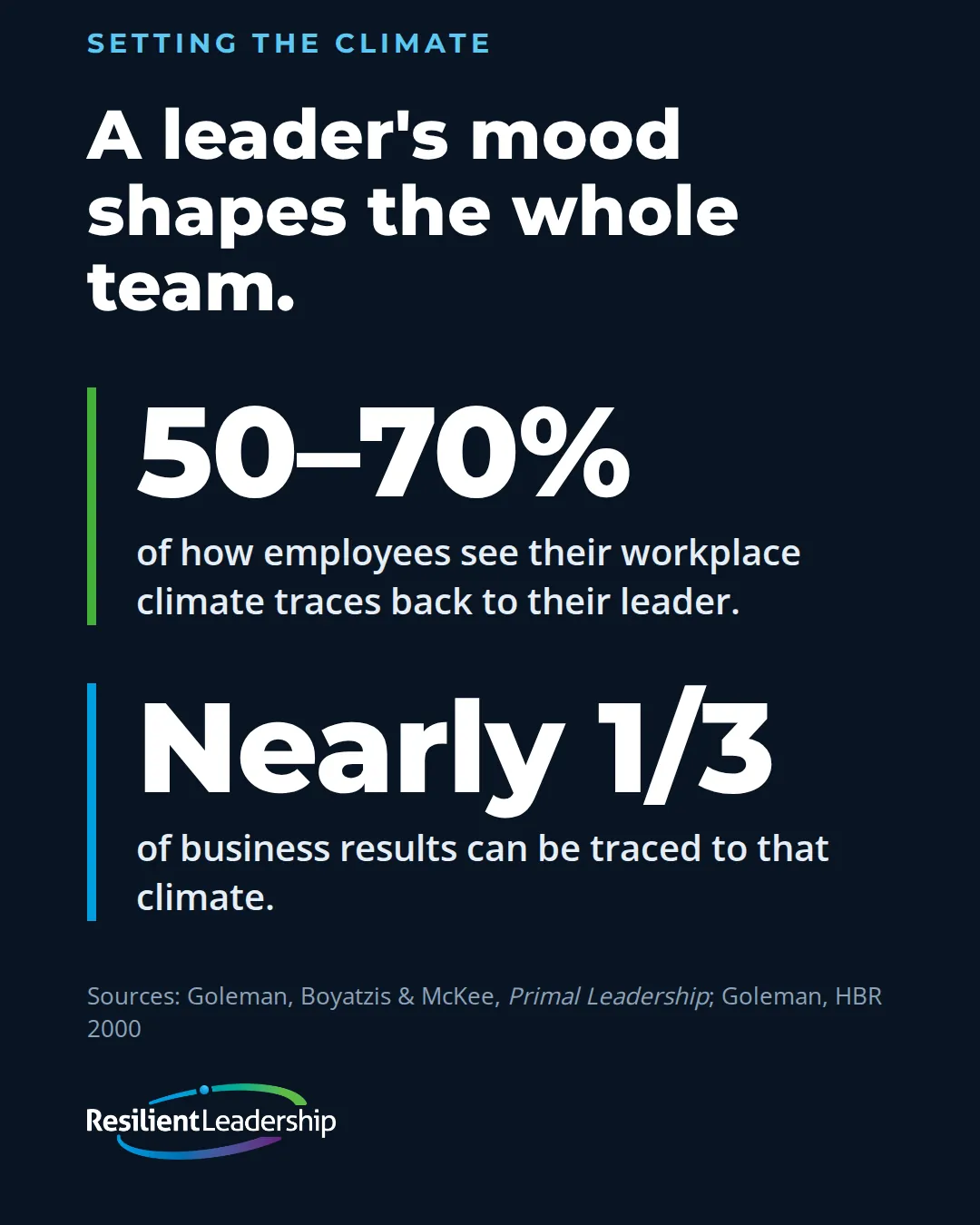
Daniel Goleman’s research has put numbers to that experience. In his Harvard Business Review article “Leadership That Gets Results,” he reported that the climate of an organization can account for nearly a third of its business results. In Primal Leadership, he and his co-authors found that roughly 50 to 70 percent of how employees perceive that climate traces back to the actions and behaviors of their leader.
Put those two findings together and the conclusion is clear. A leader’s emotional state is one of the most practical levers for performance in any organization.
Why mood spreads: the emotional system
Bowen Family Systems Theory explains why this happens. Every group of people who work closely together forms an emotional system, and anxiety moves through that system automatically, often below conscious awareness. People take their cues from whoever sits at the center, and in most organizations that’s the leader.
When a leader is anxious, irritable, or unpredictable, the people around them start scanning for danger. Thinking narrows, information gets filtered, and energy goes into self-protection. When a leader is calm and steady, people relax enough to think clearly, raise problems early, and take sensible risks. In Resilient Leadership, we describe this as the difference between a step-up and a step-down transformer. Every leader carries emotional voltage into the room, and every leader decides, moment by moment, whether to raise it or lower it.
Steadiness matters most
The goal here is steadiness. People can tell when a smile is forced, and they trust a leader whose mood is honest and predictable. A less anxious presence comes from self-regulation: noticing your own reactivity, understanding what’s driving it, and choosing a thoughtful response. Predictability builds trust, and trust gives people the security they need to do their best work.
Five practices for setting the climate
- Check your own temperature first. Before an important meeting, take a moment to notice what you’re carrying in with you. Name it, even silently. Awareness is the first step toward choosing your response.
- Get on the balcony. During tense conversations, step back mentally and watch the whole system, including your own part in it. That small distance lets your thinking catch up with your feelings.
- Read the climate honestly. Ask a trusted colleague how the atmosphere on the team changes when you’re in the room and when you’re away. Their answer is valuable information.
- Lower the voltage during change. Change raises anxiety in every system. Slow the pace, stay in contact with the people most affected, and keep your tone calm and clear.
- Use your transitions. The drive in and the drive home are natural moments to reset. Use them to decide what presence you want to bring into the next room.
The leader’s choice
Every leader holds a great deal of influence over the emotional climate of their team. That influence can feel like a heavy responsibility, and it’s also a hopeful one, because your own functioning is the part of the system you can always work on. When you steady yourself, you give everyone around you room to think, connect, and contribute.
Curious how you show up under pressure? Take the free Resilient Leadership Self-Assessment and see your Less Anxious Presence score.
Sources
- Goleman, D. (2000). “Leadership That Gets Results.” Harvard Business Review.
- Goleman, D., Boyatzis, R., & McKee, A. (2002). Primal Leadership: Realizing the Power of Emotional Intelligence. Harvard Business School Press.