
Certified Leadership Training, Coaching and Consulting for Organizations
Stat-Graphic_Combined

Setting the Climate: How a Leader’s Mood Shapes the Whole Team

A leader’s mood shapes the emotional climate of a team, and climate shapes results. What the research says, and how Bowen Theory helps leaders steady themselves.

Setting the Climate: How a Leader’s Mood Shapes the Whole Team

Most leaders can’t remember a drive home that felt lighter because of something a boss said on a Friday afternoon. Most can also remember the opposite: a single sharp comment that lingered all weekend. Those moments stay with us because a leader’s mood travels. It moves through a team quickly, and it shapes how people think, how freely they speak, and how much of themselves they bring to the work.
Stat-Graphic_CombinedWhat the research says

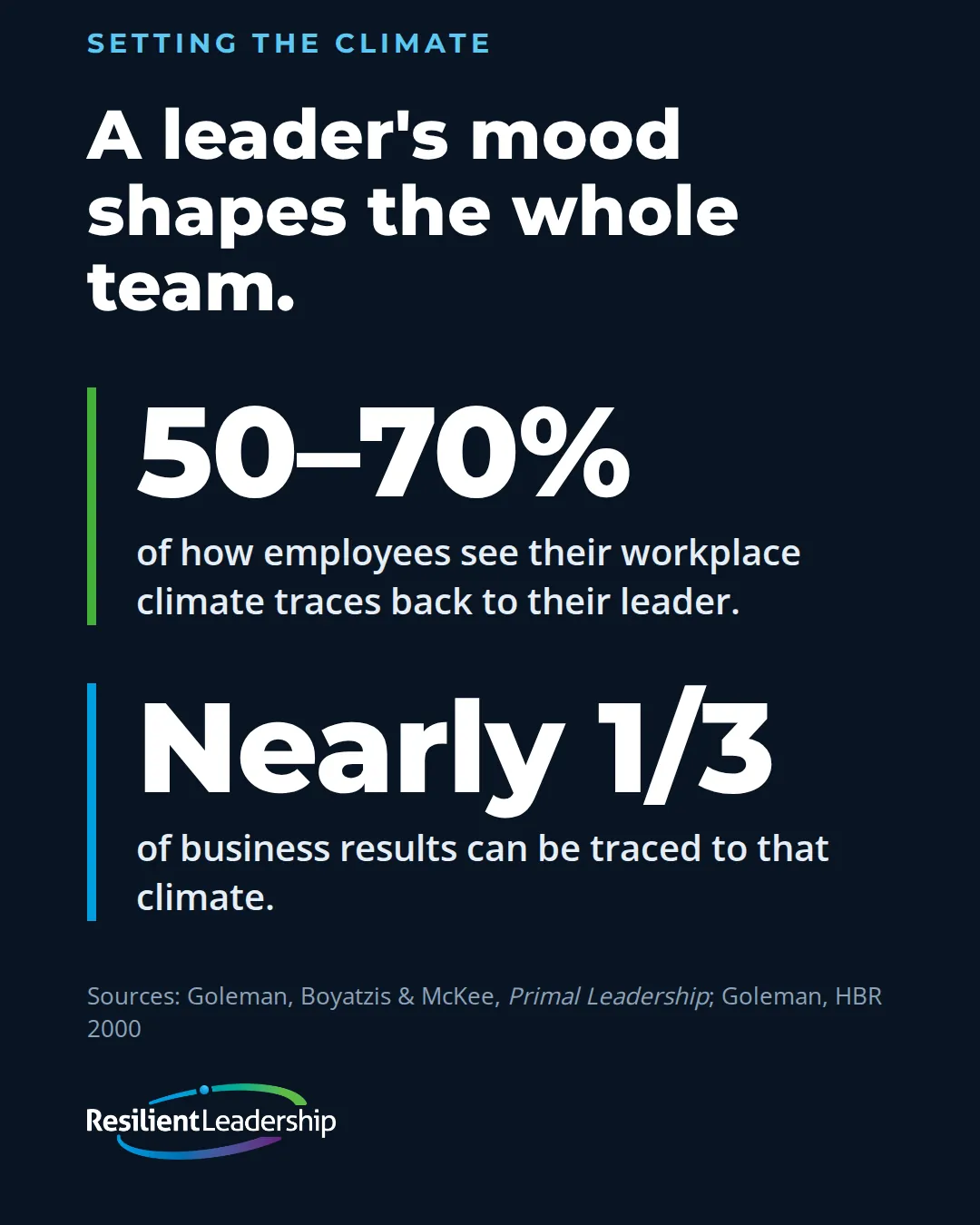
Daniel Goleman’s research has put numbers to that experience. In his Harvard Business Review article “Leadership That Gets Results,” he reported that the climate of an organization can account for nearly a third of its business results. In Primal Leadership, he and his co-authors found that roughly 50 to 70 percent of how employees perceive that climate traces back to the actions and behaviors of their leader.

Put those two findings together and the conclusion is clear. A leader’s emotional state is one of the most practical levers for performance in any organization.

Why mood spreads: the emotional system

Bowen Family Systems Theory explains why this happens. Every group of people who work closely together forms an emotional system, and anxiety moves through that system automatically, often below conscious awareness. People take their cues from whoever sits at the center, and in most organizations that’s the leader.

When a leader is anxious, irritable, or unpredictable, the people around them start scanning for danger. Thinking narrows, information gets filtered, and energy goes into self-protection. When a leader is calm and steady, people relax enough to think clearly, raise problems early, and take sensible risks. In Resilient Leadership, we describe this as the difference between a step-up and a step-down transformer. Every leader carries emotional voltage into the room, and every leader decides, moment by moment, whether to raise it or lower it.

Steadiness matters most

The goal here is steadiness. People can tell when a smile is forced, and they trust a leader whose mood is honest and predictable. A less anxious presence comes from self-regulation: noticing your own reactivity, understanding what’s driving it, and choosing a thoughtful response. Predictability builds trust, and trust gives people the security they need to do their best work.

Five practices for setting the climate

  • Check your own temperature first. Before an important meeting, take a moment to notice what you’re carrying in with you. Name it, even silently. Awareness is the first step toward choosing your response.
  • Get on the balcony. During tense conversations, step back mentally and watch the whole system, including your own part in it. That small distance lets your thinking catch up with your feelings.
  • Read the climate honestly. Ask a trusted colleague how the atmosphere on the team changes when you’re in the room and when you’re away. Their answer is valuable information.
  • Lower the voltage during change. Change raises anxiety in every system. Slow the pace, stay in contact with the people most affected, and keep your tone calm and clear.
  • Use your transitions. The drive in and the drive home are natural moments to reset. Use them to decide what presence you want to bring into the next room.

The leader’s choice

Every leader holds a great deal of influence over the emotional climate of their team. That influence can feel like a heavy responsibility, and it’s also a hopeful one, because your own functioning is the part of the system you can always work on. When you steady yourself, you give everyone around you room to think, connect, and contribute.

Curious how you show up under pressure? Take the free Resilient Leadership Self-Assessment and see your Less Anxious Presence score.

Take the free self-assessment

Sources

  • Goleman, D. (2000). “Leadership That Gets Results.” Harvard Business Review.
  • Goleman, D., Boyatzis, R., & McKee, A. (2002). Primal Leadership: Realizing the Power of Emotional Intelligence. Harvard Business School Press.

linkedin-newsletter-cover-iceberg

Above and Below the Waterline

You can think of the emotional system as the weather inside an organization. On calm days, people think clearly, share information freely, and take sensible risks. When anxiety rises, the weather changes. Thinking narrows, people protect their turf, and conversations that should take ten minutes stretch into an hour.

Above and Below the Waterline

linkedin-newsletter-cover-iceberg
In more than two decades of coaching leaders and consulting with leadership teams, I’ve watched the same puzzle play out many times. Two teams can share the same structure, the same resources, and similar talent, and still respond to pressure in completely different ways. One pulls together. The other starts to fray, and the reasons can be surprisingly hard to name.

Bob Duggan and I came to call it the hidden chemistry of an organization, and we even put the phrase in the title of our book. It grows from Dr. Murray Bowen’s insight that every group of people who spend enough time together forms an emotional system alongside its rational one.

THE RATIONAL SYSTEM
The rational system is everything you can observe, measure, and study. It includes the org chart, the strategy, the policies and procedures, the budget, and the goals on the wall. It’s the part of the iceberg above the waterline, and it’s where most management training puts its attention. That makes sense, because it’s visible, familiar, and responsive to good planning.

THE EMOTIONAL SYSTEM
Below the waterline sits the emotional system, and like the hidden part of an iceberg, it runs deeper than most leaders realize. It holds the anxiety people carry, the alliances they form, the unspoken rules about who can say what to whom, and the automatic ways people react when they feel threatened. It resists direct measurement, yet it drives a remarkable share of behavior, especially when the pressure rises.

You can think of the emotional system as the weather inside an organization. On calm days, people think clearly, share information freely, and take sensible risks. When anxiety rises, the weather changes. Thinking narrows, people protect their turf, and conversations that should take ten minutes stretch into an hour.

WHERE THE LEADER FITS
Here’s the part I find most hopeful. Leaders sit right in the middle of that emotional system, and how they show up affects everyone around them. When a leader stays calm, clear, and connected, the people around them borrow from that steadiness. When a leader gets reactive, the anxiety travels just as quickly.

That means the most important work a leader can do in a tense season often begins with themselves. It starts with seeing the emotional system clearly, including their own part in it. From there, they can think before they react and lead from their best judgment.

How do you show up under pressure? Take the free Resilient Leadership Self-Assessment

THREE QUESTIONS FOR THIS WEEK
If you’d like to start reading the hidden chemistry of your own team, carry these questions into your next few meetings.

  1. Where is tension building, and between whom?
  2. Who seems most anxious right now, and what pressures are they facing?
  3. How am I contributing to the temperature in the room, up or down?

You may be surprised by how much becomes visible once you start looking.

In the next edition of Calm, Clear & Connected, I’ll look at one of the most common patterns below the waterline, and a simple gift leaders can give their teams to change it. Until then, I’d love to hear what you notice.

Calm, Clear & Connected

Monthly insights on how steady leaders read the hidden chemistry of their teams and organizations.

Subscribe on LinkedIn →

Feeling Tense? Get Curious!

As summer gives way to fall, shifts in daylight, sleep, temperature, and time outdoors can influence mood and the body’s stress response.

Practice of the Month · October 2026

Feeling Tense? Get Curious!

Picture Dana, a project lead in a Monday budget meeting. Ten minutes in, the finance director announces a one-third cut to her team’s funding. Dana’s chest tightens, and she starts defending every line item. The finance director digs in too, and the room grows tenser by the minute.

Tension and narrow focus

Then Dana takes a breath and asks, “Help me understand what’s driving the cut.” It turns out a delayed contract has squeezed cash flow for just two quarters. With that on the table, the two of them sketch options together and leave with a plan they both support.

When anxiety rises, our attention narrows to threats and to protecting our position. That focus helps us survive, yet it crowds out the creative thinking a hard moment needs. One curious question widened Dana’s view.

As RL founder Jim Moyer often says, it is next to impossible to be both curious and anxious at the same time.

Why practice makes the difference

Neuroplasticity, the brain’s ability to rewire itself through experience, means the responses we repeat become the ones we reach for. The more often you meet tension with curiosity, the more natural that response becomes.

Try it this month

The next time tension rises in a meeting or conversation, press your inner pause button and ask yourself one of these questions:

  1. What is raising my tension right now?
  2. What is the real roadblock here?
  3. What can the two of us still agree on?
  4. What might I, or the group, be missing?
  5. What question could help us move forward?

The RL Practice

Pause. Get curious. Ask a thoughtful question.

Whatever the mood around you, your response is yours to choose. Choosing curiosity helps you and your team stay calm, stay connected, and stay the course.

Where do you tend to react?

Take the free RL Self-Assessment to see where you tend to react and where you lead with calm.

Take the free RL Self-Assessment →

To learn more about how to SEE, THINK and LEAD more effectively using the principles of Resilient Leadership, please contact us at resilientleadershipdevelopment.com.

We’ll be back next month with another practice you can put to use right away. Until then, stay calm, stay connected, and stay the course.


A 10-Minute Practice for the Season Ahead

As summer gives way to fall, shifts in daylight, sleep, temperature, and time outdoors can influence mood and the body’s stress response.

A 10-Minute Practice for the Season Ahead

Practice: Steadying Through the Seasonal Shift

Seasonal changes affect anxiety more than most people realize. As summer gives way to fall and winter, shifts in daylight, sleep, temperature, routines, and time outdoors can all influence mood and the body’s stress response. It’s a real physiological pattern — and one that responds well to a few specific, practiced approaches.

Three commitments matter here: Stay Calm, Stay Connected, and Stay the Course. The first two show up directly in the practices below. The third is what carries last month’s practice forward: SEE, THINK, and LEAD only work if you keep making those moves, meeting after meeting — especially in a week when they don’t seem to be landing. These approaches are well-established and proven to work, and the people who benefit most are those who stay with them.

A Few Approaches That Help

  1. Keep your sleep schedule consistent. Go to bed and wake up at roughly the same time every day. Sleep disruption can amplify anxiety.
  2. Get daylight early in the day. Twenty to thirty minutes of outdoor time in the morning helps regulate your body clock and mood, especially as daylight decreases.
  3. Exercise regularly. Walking, swimming, cycling, or other moderate movement most days reduces physical tension and improves sleep.
  4. Maintain your routines. Seasonal transitions can disrupt meals, exercise, social activity, and hobbies. Predictability has a calming effect.
  5. Stay connected with people. (Stay Connected) It’s easy to drift toward isolation as days shorten. Deliberately scheduling enjoyable social contact counters that pull.
  6. Use a simple calming technique. (Stay Calm) Slow breathing — in for about 4 seconds, out for about 6 — for five minutes lowers the body’s physiological arousal.
  7. Watch caffeine and alcohol. Both can worsen anxiety and interfere with restorative sleep, especially when you’re already feeling unsettled.
  8. Notice the pattern. For a few weeks, track your anxiety level, sleep, exercise, daylight exposure, and major stresses. A predictable seasonal pattern often emerges — [tie back to last month’s post here].

10-Minute Daily Routine for Seasonal Anxiety

Leaders are often quick to regulate everyone else’s anxiety while paying little attention to their own — overfunctioning for the team, underfunctioning toward self. This routine flips that ratio in ten minutes.

  • Minutes 1–2 — Slow your breathing. Sit comfortably, relax your shoulders, and breathe gently through your nose for about 4 seconds, then exhale for about 6. No need to force a deep breath. Continue for two minutes.
  • Minutes 3–5 — Get grounded. Shift attention from anxious thoughts to what’s actually happening around you. Identify 5 things you can see, 4 you can feel, 3 you can hear, 2 you can smell, and 1 you’re grateful for.
  • Minutes 6–8 — Move. Stand up and move — walk around the house, stretch, do a few gentle squats, or step outside for a few minutes. Timing this with morning daylight makes it more effective.
  • Minutes 9–10 — Set your direction. Ask three questions:
  1. What am I concerned about today?
  2. Is there something practical I can do about it?
  3. What’s one good thing I want to do today?

Choose one small, doable action and let curiosity carry you into the rest of the day.
Bonus habit: A 20–30 minute outdoor walk most days, earlier rather than later, combines daylight, movement, a change of scenery, and a break from repetitive thinking — and it makes everything above considerably more effective.
The goal is a settled nervous system and the ability to choose how you spend the rest of your day, regardless of what anxiety is doing in the background.

When to Get Additional Support

If anxiety becomes persistent, interferes with sleep or daily activities, or comes with significant depression, it’s worth bringing to a physician or mental health professional. Cognitive behavioral therapy (CBT) is particularly well established for anxiety, and if symptoms reliably surface during darker months, a clinician can help assess whether seasonal affective disorder (SAD) or another seasonal pattern is involved.

We’ll be back next month with another practice you can put to use right away. Keep an eye on your inbox — and until then, stay calm, stay the course, and stay connected. Our monthly Practice Forums are 45-minute discussions where we work through how these practices play out in real team dynamics.

Click below to join our discussion group!
https://www.resilientleadershipdevelopment.com/45-minute-practice-forum-registration/

This month’s session will be Friday, September 4th @ 12:00 PM EST.

→ Explore the RL Coach Certification Program if you’re ready to bring this framework to other leaders. https://www.resilientleadershipdevelopment.com/resilient-leadership-coach-certification-program/

Article Contributors

John Moyer

RL Trainer, John Moyer contributed to this article.
As a 30+ year veteran of education, John has trained and coached both student and adult leaders. Through his work primarily in education, John has helped leaders of all ages discover that leadership is influence- which starts with the leader becoming a less anxious presence. Email John

Robert-Wilkins

Robert Wilkins, contributed to this article.
As a 35-year veteran of website design, development, and content creation, Robert brings that same discipline to his work at RLD. A long-time practitioner of Resilient Leadership principles himself, he's seen firsthand how the model shapes not just leadership, but the everyday work of building and communicating. Email Robert.

What you do in the 90 seconds after

What you do in the ninety seconds after?

A Resilient Leadership approach comes down to three moves, repeated over and over can provide calm, clarity, and conviction.

What you do in the ninety seconds after?

Every leader has a moment where the room gets tense and the default wiring kicks in. Someone pushes back. Numbers are down. A conflict that’s been simmering finally boils over. The question isn’t whether that moment comes. It’s what you do in the ninety seconds after it does.

What you do in the 90 seconds after

A Resilient Leadership approach comes down to three moves, repeated over and over: SEE the emotional pattern underneath the problem. THINK your way past the urge to react. LEAD by choosing your response on purpose. Then do it again in the next meeting. And the one after that.
Here’s what that looks like in practice — the first three we want you to know:

  • Practice Systems Thinking. Zoom out from the immediate flashpoint and notice the wider pattern — who’s avoiding what, who’s over-functioning to compensate, who’s gone quiet and cut off. The visible conflict is rarely the whole story.
  • Take Frequent Pauses. A pause before you respond gives your anxious brain time to settle. That gap is where intention replaces impulse. It can be as small as taking one breath before you answer a pointed question in a meeting, instead of firing back.
  • Lead with Curiosity. Curiosity is the fastest way to interrupt anxiety. It turns fear-based assumptions into open questions, and open questions are what actually move a group toward clearer thinking.

These three practices are simple to name and genuinely hard to live out under pressure — which is exactly why we built our programs around practicing them, not just discussing them. Next month, we’ll share three more.
If you want to go deeper on this work now:

→ Join our next Practice Forum
Our monthly Practice Forums are 45-minute discussions where we work through how these practices play out in real team dynamics.
This month’s session will be Friday, August 7th @ 12:00 PM EST.

→ Explore the RL Coach Certification Program if you’re ready to bring this framework to other leaders. https://www.resilientleadershipdevelopment.com/resilient-leadership-coach-certification-program/

Article Contributors

John Moyer

RL Trainer, John Moyer contributed to this article.
As a 30+ year veteran of education, John has trained and coached both student and adult leaders. Through his work primarily in education, John has helped leaders of all ages discover that leadership is influence- which starts with the leader becoming a less anxious presence. Email John

Robert-Wilkins

Robert Wilkins, contributed to this article.
As a 35-year veteran of website design, development, and content creation, Robert brings that same discipline to his work at RLD. A long-time practitioner of Resilient Leadership principles himself, he's seen firsthand how the model shapes not just leadership, but the everyday work of building and communicating. Email Robert.

Mind the Gap

Minding the Empathy Trap

It’s unlikely to find someone willing to argue that empathy is not a good thing. In fact, from a professional perspective, it’s often touted as one of the most important qualities for leadership. Leaders who can understand and connect with the experiences of others are more able to build…

Minding the Empathy Trap

Mind the Gap

It’s unlikely to find someone willing to argue that empathy is not a good thing. In fact, from a professional perspective, it’s often touted as one of the most important qualities for leadership.

Leaders who can understand and connect with the experiences of others are more able to build trust, strengthen relationships, and create environments where people feel seen and valued.

Yet empathy, just like many strengths, can become problematic when it’s overused or misapplied.

An empathy trap is what happens when empathy shifts from understanding another person’s experience to instead absorbing it and then taking actions that relieve one’s own discomfort rather than supporting the other person’s growth.

This can also be an emotional pathway into overfunctioning and is where many well-intentioned leaders find themselves getting into trouble.

Carrying Instead of Caring

Most leaders have experienced some version of the following scenario:

An employee is struggling. Perhaps they are overwhelmed by a project, frustrated by a conflict with a colleague, or anxious about a new responsibility. Wanting to help, the empathetic leader steps in. They offer to take on part of the work, solve the problem, smooth the path, or maybe even shield the employee from consequences.

The immediate aftermath of these kinds of actions often feels positive because pressure decreases, the employee feels relieved, and the leader feels they have been helpful.

Until the same or a similar issue resurfaces, again … and again.

What initially was meant to be compassionate support may have ended up unintentionally hampering the employee’s opportunity to develop new skills, confidence, and resilience.

In situations like these, it can be more useful to discern when feelings of empathy begin slipping into over-identification.

A leader who is empathetic says:

“I can understand what this is like for you.”

But a leader who is over-identified says:

“I feel what you feel, and now I need to make it stop.”

The first response creates connection.

The second response often leads to rescuing.

Highly empathetic leaders seem to be particularly vulnerable to this kind of over-functioning. Because they experience others’ distress so intensely, they may feel compelled to alleviate it quickly even when that means taking burdens on themselves.  And because this kind of over-functioning is reciprocal, the consequences of such choices are not confined to a single individual or circumstance.

When leaders consistently over-function for some people, they often under-support others. So high performers may end up shouldering additional responsibilities while chronic underperformance may be unintentionally introduced and reinforced because the system adapts around it rather than addressing it. Meanwhile, beneath the surface, anxiety and resentment build. And something that began with the intention of compassion to an individual can gradually end up undermining both fairness and accountability in the greater organizational system because rather than increasing capability a dependency was created.

Leadership Core Strength

Just as our body’s core muscles help us remain upright and balanced under strain, leadership requires a similar set of internal capacities that allow us to stay present in the face of discomfort without immediately attempting to eliminate it.
These core muscles include elements that are also key to resilient leadership:

  • Emotional regulation: remaining steady when others are upset.
  • Tolerance for discomfort: resisting the urge to immediately remove struggle.
  • Clarity of role: supporting growth rather than rescuing.
  • Curiosity under pressure: asking instead of fixing.
  • Healthy boundaries: avoiding the temptation to take ownership of someone else’s work.

Just like physical strength training, repetition is key to cultivating these capacities. Ultimately, the goal being not to eliminate the desire to help, but to hone and strengthen a leader’s ability to notice when the emotional impulse to rescue arises and to create space in which they can intentionally choose actions that foster growth rather than rush to comfort.

Productive Discomfort

Most of us unconsciously equate discomfort with harm. When you think about it, though, growth almost always involves some degree of discomfort.

Common professional experiences like learning a new skill, receiving feedback, navigating conflict, and taking responsibility can all be uncomfortable. Yet, all are also necessary for growth – evidence that discomfort is not necessarily a problem to solve because it is often the very condition required for development.

The leader’s role is to cultivate an environment where people can navigate challenges, build and expand their capability, while also knowing they are not alone.

To do this, leaders need to be close enough to support and influence, while remaining differentiated enough to avoid falling into the empathy trap and carrying the experience for someone else.

Choosing with Intention

Empathy traps rarely announce themselves with signage, instead they tend to just show up in the moment – perhaps as an urge to jump in and fix, or maybe as a desire to make things easier, even as a temptation to solve a problem that someone else is likely capable of solving on their own.

It is in these moments that leadership core strength is really developed.

Every time we notice the impulse to rescue and choose instead to remain curious, we can strengthen our capacity to lead more effectively.

Try this:  When you find yourself in that moment, teetering on the edge of an empathy trap, instead of immediately offering solutions or comfort, try to lean into curiosity and offer empowering questions such as:

  • “What do you think the next step might be?”
  • “How have you handled something similar before?”
  • “What feels most challenging about this?”
  • “How can I support your thinking about this?”

Asking questions can also help shift responsibility back where it belongs while still communicating care and support.

A particularly useful phrase is:  “I’m here to think it through with you, not solve it for you.”

Wrap-Up

It is often far easier, in the moment, to just step in and solve. Doing so can create a sense of quick relief and can even make us feel effective, but rescuing weakens individuals and systems over time.

Leadership is not simply about solving problems. It is about developing the capacity of others to solve them.

So, the next time you find yourself in that moment of choice between offering comfort or challenge, remember:

  • The goal is not to be the most helpful person in the room.
  • The goal is to create a room where more people become capable.

A. Eileen Wiediger

EileenWiediger, Certified Resilient Leadership Coach

Eileen is an ICF-certified coach who empowers individuals at all levels to navigate the dynamic journey from self-awareness to self-transcendence. She has worked as a strategist, instructional designer, and facilitator solving complex problems and creating systems for learning and growth. You can reach her at: https://www.linkedin.com/in/a-eileen-wiediger/ or through her website: https://www.steeproad.com.

The Patterns that Persist

The Patterns That Persist

Imagine someone who never moved on from the worst day of their life. She still wears the dress from that day. The table is still set. The once-white cake, now yellowed beneath layers of cobwebs, still sits where it was left. Time moved forward. She didn’t.

The Patterns That Persist

The Patterns that Persist

Imagine someone who never moved on from the worst day of their life. She still wears the dress from that day.
The table is still set.
The once white cake, now yellowed beneath layers of cobwebs, still sits where it was left.

Time moved forward. She didn’t.

Charles Dickens, in his book Great Expectations, gave her a name: Miss Havisham. It’s easy to believe that only extreme characters live so visibly in the grip of their past.
But most of us are shaped by old experiences, inherited habits, and unfinished stories in ways we are frequently unaware of. The difference is that we tend to carry the lingering remnants of our past within rather than wearing them for everyone to see.

Whenever you walk into the office (or anywhere), you’re not walking in alone.
Neither is anyone else.

Influence from the Past

The echoes of the past still sound beneath present-day interactions, shaping our reactions and responses.

For years, professional culture encouraged striving for a kind of emotional separation: leave your personal life at home and bring your professional self to work.  The problem with that line of thinking is human beings don’t actually function like that.

Wherever we go, so go our experiences. So the question becomes not whether our personal past influences us. The question is whether we recognize how it influences us.

Seeing the Patterns in Ourselves

The first task is to become aware of the legacies we carry and learn to identify the ways they show up in our thoughts, reactions, and relationships.  Keeping in mind that not all patterns are problems waiting to be solved.

Many of our tendencies developed for good reasons and may have served us well. Think about how the person who learned to anticipate needs as a coping strategy may become highly empathetic and attentive. The individual who grew up taking responsibility early may become dependable and capable under pressure. Or someone who learned to carefully read the emotional environment may become perceptive and relationally skilled.

The challenge is that strengths developed in one context can become limitations in another.

To recognize these patterns in ourselves, we need to tune in to how experiences impact our behaviors: how we respond under pressure, cope with conflict, seek approval, avoid vulnerability, or attempt to maintain control.  These habits of response are often subtle, typically show up indirectly in recurrent reactions rather than through dramatic disclosures.

Key indicators that an underlying historical dynamic – whether helpful or limiting – might be at work are repetitive thoughts or emotional responses.

Try this:

Be on the look-out for self-talk or ways of responding that feel overly familiar, that give you a sense of déjà vu. When they show up, pause and get curious:

  • “Where have I experienced this before?”
  • “At what other times has this story shown up?”
  • “Where did this come from?”
  • “Is this serving me or limiting me in this circumstance?”

Noticing Patterns in Others

Recognizing these patterns in ourselves first can help us respond differently to others. The goal is not to psychoanalyze colleagues or to rationalize their behavior, but to heighten our awareness in a way that creates space for curiosity rather than rushing to an assumption or snap judgment.
Sometimes what we experience as difficult behavior in others may actually be an overextension of one of their strengths.

  • The highly dependable employee may struggle to delegate.
  • The deeply empathetic leader may overfunction for others.
  • The person who values harmony may avoid necessary conflict.
  • The independent colleague may resist asking for help.

Often, the very qualities that contribute to someone’s effectiveness can become constraining when they are applied automatically rather than intentionally.

Try this:

The next time a colleague’s behavior irritates or confuses you, see if you can slow your own response and replace judgment or frustration with curiosity:

  • What need, concern, or strength might be operating beneath the surface?
  • What assumptions am I making?
  • What assumptions might my colleague be making?
  • What else might explain what I’m observing?

Recognizing Organizational Legacies

Not all the patterns we fall into are personal. Some are cultural, organizational, or collective.
When I worked in the corporate world, we had a phrase for getting caught up in these kinds of group dynamics: going native.  Over time, people gradually absorbed the norms, assumptions, and relational habits of the systems around them. Without consciously realizing it, their own reactions and behaviors shifted to align with the culture around them.

We don’t just bring the heritage of our past experiences and family systems into work; work systems can shape us too.

A fundamental concept of Resilient Leadership is that every organization is comprised of both a rational and an emotional system.  Like an iceberg, the rational system (strategy, structure, goals) is what is easily observed above the water line. Beneath it lies the emotional system, where these inherited patterns lurk and operate, largely hidden from awareness.

The challenge is that although not clearly visible, these emotional legacies are remarkably persistent.  Leadership changes, restructures happen, people come and go; yet these underlying and unseen patterns often remain intact.

It is a rare organization that takes the time to explore the details of its emotional system inheritance. In fact, looking to the past in this way is often dismissed as being a waste of time at best and a problematic re-invigorating of old grievances at worst. Yet without this background, organizations can remain stuck in entrenched patterns they aren’t aware of and don’t fully understand.
Fortunately, even when these dynamics aren’t openly discussed, they can be observed because patterns leave clues.

Try this:

Organizational legacies often reveal themselves through repeated stories, assumptions, or familiar phrases. Learn to listen for clues such as:

  • “That’s just how things work around here.”
  • “We tried that before.”
  • “We’ve never … “
  • “People around here always …”

Then ask yourself:

  • What belief or history might sit beneath this?
  • What strengths has this created?
  • What limitations might it also create?
  • How might this be explored and illuminated?

What We Carry Forward

Resilient Leadership isn’t about becoming perfectly self-aware or emotionally detached, nor is it about erasing organizational or personal pasts and experiences.  It’s about developing the ability to notice and get curious about the invisible influences that impact us and the systems we operate in.

Miss Havisham lived in and wore her past for everyone to see.  Most of us do not.  Yet our histories still show up in ourselves, in our relationships, and in the organizations we build.

Awareness creates choice and the possibility of carrying forward those inheritances that serve us well while releasing what does not.

EileenWiediger, Certified Resilient Leadership Coach

Eileen is an ICF-certified coach who empowers individuals at all levels to navigate the dynamic journey from self-awareness to self-transcendence. She has worked as a strategist, instructional designer, and facilitator solving complex problems and creating systems for learning and growth. You can reach her at: https://www.linkedin.com/in/a-eileen-wiediger/ or through her website: https://www.steeproad.com.

Transforming-Triangles

Transforming Triangles

After spending over two hours with a technical expert to troubleshoot issues with my cell phone, I ended up driving home with no resolution and a factory-reset phone that I would have to manually restore. On my silent, disconnected drive home without navigation or tunes…

Transforming Triangles

After spending over two hours with a technical expert to troubleshoot issues with my cell phone, I ended up driving home with no resolution and a factory-reset phone that I would have to manually restore.

On my silent, disconnected drive home without navigation or tunes – the reset having rendered the phone unable to connect with CarPlay – I could feel annoyance and frustration rising.

Still fuming, I opened the door to my house … to be met by my toy fox terrier, Tugboat.

Transforming-Triangles

He didn’t ask what happened. He didn’t try to fix it. He didn’t take a side. Instead, he just bounded toward me, acting like my return home was the most important event of his day.  Within a few moments, I noticed the tight coil of stress begin to loosen. My shoulders relaxed and I even found myself smiling as he insisted on a greeting that required me to step out of my rumination and into the moment.

Nothing about the situation with my phone had changed. But something in me had.

In that moment, Tugboat became the third point in a triangle I didn’t even realize I had entered – a triangle between me and a frustrating experience with a technician that had begun to consume my attention and elevate my stress. Without intention or technique, he did what healthy triangles do best: he absorbed none of my tension, amplified none of my frustration, and yet somehow, he helped dissipate both.

He didn’t pull me further into the problem. He helped me step out of it just enough to regain perspective.

We often talk about triangles as something to avoid.  But what if the real skill isn’t avoiding them, but figuring out how we can make them beneficial and productive when find ourselves in one?

The reality is, a triangle is not inherently toxic; it is, in fact, a structure that regulates stress by offering a pathway to offload and defuse difficult situations.  When tension between two people rises to a level that is beyond what they can navigate, there is often a natural inclination to recruit a third person, which can create stability.  In essence, triangulation is a signal that the system is attempting to regulate itself when under pressure.

The problem isn’t that leaders get pulled into triangles, the problem is that most leaders don’t know how to lead from within one.

Toxic vs Transformative Triangles

In unhealthy triangles, stress becomes fuel for dysfunction.  Instead of creating stability, they further anxiety and stress due to reactive thinking and behavior, which is often driven by old feelings and automatic actions/reactions.  Anxiety travels around the triangle, due to reactivity, moving from one person, to the other, to the next; frequently creating even more triangles in response.  These dysfunctional triangles foster anxious and more reactive systems.

Healthy triangles can be transformative as stress becomes fuel for growth.  They foster calmer and less reactive systems and are characterized by clear thinking and thoughtful, intentional behaviors among those involved.

Toxic Triangle Characteristics Transformative Triangle Characteristics
Secrecy Transparency
Blame Curiosity
Emotional dumping Emotional processing
Avoidance of direct conversation Preparation for direct conversation
Expands and prolongs stress Diminishes and redistributes stress

Three Steps to Shift from a Toxic to Transformative Triangle

1.Take in (not take sides)

  • Receive the stress without absorbing the narrative as truth.
    • “I hear this is frustrating, help me understand what matters most here.”

2.Transform (not transmit)

  • Shift the energy from reactivity to reflection.
    • Slow it down
    • Notice and name patterns
    • Distinguish facts from interpretation

3.Transfer back (with intention)

  • The triangle is not the end point; think of it as a staging ground.
    • “What would it look like to share this directly with this person in a way that moves things forward?”
  • Toxic triangles trap energy
  • Healthy triangles process and return it

Wrapping it Up

Triangles don’t disappear as systems mature, but they can become more conscious and act as positive catalysts for redistributing systemic anxiety.  The goal for leaders is not to avoid or step out of triangles, but to practice stepping into them and participating differently – using their presence to shift from toxic to transformative.

EileenWiediger, Certified Resilient Leadership Coach

Eileen is an ICF-certified coach who empowers individuals at all levels to navigate the dynamic journey from self-awareness to self-transcendence. She has worked as a strategist, instructional designer, and facilitator solving complex problems and creating systems for learning and growth. You can reach her at: https://www.linkedin.com/in/a-eileen-wiediger/ or through her website: https://www.steeproad.com.

Balancing the Seesaw: Overfunctioning, Underfunctioning, and the Work In Between

Balancing the Seesaw: Overfunctioning, Underfunctioning, and the Work In Between

Overfunctioning and underfunctioning, forms of anxiety-driven reactivity, are frequent topics in Resilient Leadership coaching. They exist in a reciprocal dynamic, like a seesaw: when one appears…

Balancing the Seesaw: Overfunctioning, Underfunctioning, and the Work In Between

Balancing the Seesaw: Overfunctioning, Underfunctioning, and the Work In Between

Overfunctioning and underfunctioning, forms of anxiety-driven reactivity, are a frequent topic in Resilient Leadership coaching. They exist in a reciprocal dynamic, like a seesaw: when one appears, it is almost always enabling the other somewhere else in the system.

Yet what many struggle with most is a subtler form of overfunctioning. It often goes undetected because it doesn’t show up in the usual, observable ways. Although their calendars may look manageable, their task lists entirely reasonable they still experience a kind of lingering mental exhaustion, that rest doesn’t resolve. Some of my clients have described it as something feeling just slightly too heavy, a weight they can’t shift.

This type of overfunctioning isn’t rooted in what they’re doing, but in what they’re feeling responsible for.

Different Kinds of Overfunctioning
When most people hear the word “overfunctioning,” they think of things that are observable and quantifiable like too many tasks, too many hours, or a workload that has exceeded capacity. But below that visible and more observable layer, lies emotional overfunctioning that comes from feeling responsible for outcomes, feelings, and situations that belong to someone else. Things like worrying about another colleague’s performance on a new project or a team member’s low morale you feel personally accountable for lifting.

These are not the types of things that show up on a calendar or a to-do list, but they carry weight nonetheless. Oddly enough, the solution to this kind of emotional overfunctioning isn’t to do less. It’s to feel less responsible for what was never yours to own.

The Camouflage Problem
One reason this kind of overfunctioning can be hard to discern is that it rarely announces itself as overwork or stress. Instead, it can show up dressed as conscientiousness or as caring. The very qualities many of us may have been rewarded for, which makes them genuinely difficult to examine with any sense of critical distance.

This feeling of responsibility, particularly for leaders, can be so seamlessly integrated into a sense of professional identity that questioning it can feel like questioning who you are. And so the overfunctioning goes unchecked, keeping up a sort of low-grade vigilance that runs in the background even during the hours when you’re supposed to be off.

This is anxiety doing what anxiety does best; generating the illusion that our worry and our readiness to step in is what’s keeping things from going wrong.

Seeing the Seesaw
Like a seesaw, every system – whether a team, a family, an organization – seeks a kind of equilibrium. When one person consistently carries more than their share of emotional or functional weight, the system adjusts. Someone, somewhere, carries less in response. It happens, usually unconsciously, through the ordinary gravitational pull of repeated patterns.  The more reliably you step in, the less necessary it becomes for others to step up. Not because they’re lazy or unaware, but because the system has found its balance although it’s perhaps not a particularly healthy one.

And this is where systems thinking becomes so valuable, because the reciprocal dynamic doesn’t always show up in the most obvious place. It may not be the person you’re overfunctioning for who begins to underfunction. The imbalance can ripple elsewhere; into your own capacity to lead in other areas, into relationships where you’re no longer as present, even into the parts of yourself that have gone unattended while you were busy managing everyone else’s portion of the world.

All of this means the act of balancing the seesaw is never just personal. When you take your hands off something that wasn’t yours to hold, you are doing something for the system, not just for yourself. You are creating the conditions for someone else to discover that they too are competent and capable, which may be something that your steady presence in the gap has been unintentionally hindering.

A Practice of Feeling Less Responsible
If the problem lives in the emotional world, the practices need to meet it there and that means starting with awareness before moving to action.

Notice what responsibility actually feels like in your body. Emotional overfunctioning can have physical signatures such as low-grade tension, a particular kind of alertness that doesn’t switch off, or a heaviness that settles in around certain people or situations. Getting familiar with that felt sense is the first step toward recognizing it earlier.

Get curious about the story underneath the feeling. When you notice yourself feeling responsible for someone else’s outcome, it’s worth asking: what do I believe will happen if I don’t step in? The fear is usually specific, even if it’s rarely examined. And when it is examined, it often turns out to be less inevitable (and less yours to prevent) than underlying anxiety has been insisting.

Practice distinguishing concern from ownership. Concern for someone is relational and healthy; it keeps us connected and present. Ownership of their outcomes is something different because it assumes their results are primarily ours to produce or prevent. The difference can be subtle, but learning to feel it is one of the more useful things a leader can develop.
Experiment with staying in the room without picking up the rope. The behavioral experiment that corresponds to this inner work is simply this: the next time you feel the urge to step in, pause. Don’t suppress the impulse; just notice it, name what you’re feeling responsible for, and wait. See what happens. More often than not, the system responds and someone else steps forward. The crisis doesn’t materialize. Or if it does, it turns out to be workable and informative for everyone involved, not just you.

Trust the reciprocal nature of the system. This may be the hardest practice of all, because it requires tolerating the uncertainty of not knowing exactly how things will unfold when you stop managing them. But the seesaw truly does rebalance. Adjusting your functioning, most especially your emotional functioning, is where you have choice and influence. You don’t have to orchestrate the outcome on the other end.

Closing Thoughts
There is a meaningful difference between being deeply committed to the people and work around you and feeling personally accountable for others’ performance and outcomes. The first is leadership. The second is exhaustion, albeit often cloaked in a very convincing costume.

The invitation here is to get curious about your own overfunctioning not by not just looking at what’s on the calendar or the to-do list, but by reflecting on what shows up in your inner experience. Consider where you might be carrying an emotional sense of responsibility for others that was never meant for you to carry.  And what might become possible, not only for you but for others on your team or in your organization, if you were to choose to put it down.

📞 Curious about how cultivating conviction can strengthen your leadership? Call, click, or email us today to start the conversation.
EileenWiediger, Certified Resilient Leadership Coach

EileenWiediger, Certified Resilient Leadership Coach

Eileen is an ICF-certified coach who empowers individuals at all levels to navigate the dynamic journey from self-awareness to self-transcendence. She has worked as a strategist, instructional designer, and facilitator solving complex problems and creating systems for learning and growth. You can reach her at: https://www.linkedin.com/in/a-eileen-wiediger/ or through her website: https://www.steeproad.com.

Lead With Calm and Clarity now

Master the Resilient Leadership framework to stay grounded, think clearly, and lead effectively under pressure.

Experience our immersive coaching framework in action. Join us on Mar 6 to learn practical skills you can use the same day.
Click here to learn more about our Coach Certification Programs

Cultivating & Calibrating Connection

Cultivating & Calibrating Connection

Watching Alysa Liu perform her Olympic free skate, which earned her a gold medal, I noticed something beyond her technical brilliance. The arena was electric; the audience’s response was overwhelming – just watching from my couch, far from Milan, I felt caught up in the excitement and enthusiasm.

Cultivating & Calibrating Connection

Watching Alysa Liu perform her Olympic free skate, which earned her a gold medal, I noticed something beyond her technical brilliance. The arena was electric, the audience’s response was overwhelming – just watching from my couch, far from Milan, I felt caught up in the excitement and enthusiasm.

Cultivating & Calibrating Connection

Alysa was visibly in a relationship with the cheering crowd, but at no point did she appear to be swept away by the high energy surging all around her. She was connected to her audience, but not enmeshed or engulfed. She was focused on her performance, but not remote or isolated.

And it struck me that this is what a healthy connection looks like in leadership: responsive, energized, and still self-possessed. At its worst, conviction can harden. When it’s overplayed, it can shift into rigidity, forcefulness, or stubborn attachment to plans and ideas that no longer serve. When conviction becomes immovable, it can shut down dialogue and foster a culture of compliance rather than engagement.

Challenges of Connection

In an era where there are oh-so-many ways to stay connected, it might be hard to see how connection could be a problem – unless, of course, the Wi-Fi network goes down and civilization collapses before lunch. And yet, despite these myriad communication options, I find that connection is one of the most frequent sources of strain in both my coaching practice and my personal experience.

“I wish everyone would just leave me alone so I can focus on getting things done!”

“I feel like I’m out of the loop, no one is talking to me, and I’m in the dark about what is going on!”

Both frustrations point to either end of the same tension. Staying connected, one of the core principles of Resilient Leadership, seems straightforward. Surely, this is the easy one! Yet as statements like these illustrate, the connection between human beings is not simplistic because in every relationship we are navigating a paradox: the need for closeness and belonging contrasted with an equal and opposing need for autonomy and individuality. Thus, connection is never just about access; it’s really about balance.

Calibrating Connection

Most of us have a default leaning toward one side or the other, which is not a limitation on capacity, but a preference based on comfort. The more we are aware of that tendency, the more flexibly we can adjust when circumstances or the needs of others require something different from us – adjustment being the operative word here. Connection is not something you can just set and forget, it’s a living calibration. Needs shift, contexts change, pressures rise and fall; and leaders, especially, must keep re-tuning their position on this continuum of connection so they are able to be close enough to influence, yet distant enough to lead.

Complicating matters further, research indicates that when anxiety is thrown into the equation it can push us toward the extremes of connection. Under stress, those who prefer closeness may over-attach or over-involve themselves, while those who prefer greater independence may withdraw or go silent. In times of uncertainty, the risk is not disconnection, it’s imbalance. Conscious and intentional connection is not just helpful, but essential.

Because this balance is dynamic, not static, it can be helpful to approach connection as an ongoing practice rather than a personality trait. The goal isn’t to become more distant or more available by default, it’s to become more responsive to the ever-shifting dynamics around us.

Attending to Connection

As with so many things in life, cultivating healthy connections begins with awareness. Responsiveness is only effective when there is clear seeing of the situation, the other person, and your own internal state. When that clarity is missing, what looks like a connection can slide into entanglement or withdrawal.

A practical place to start is noticing indicators that signal imbalance. These may show up in your own behavior, in others, or in the broader organizational climate. Think of them as early-warning lights on the dashboard; they aren’t judgments, rather, they are opportunities to recalibrate.

Indicators of Over-Closeness (Enmeshment)

Too much closeness can often blur boundaries and impede leadership perspective. It can look like:

  • Taking sides rather than staying curious
  • Over-identifying with another’s discomfort or problems to the point that your own effectiveness drops
  • Difficulty distinguishing your responsibilities from those that belong to others
  • Feeling compelled to fix, rescue, or absorb problems
  • Discomfort when not included, consulted, or in close contact
  • Loss of decision neutrality
  • Difficulty identifying and maintaining boundaries

Indicators of Over-Distance (Disconnection)

Too much distance reduces trust, the flow of information, and the ability to influence. It can look like:

  • Physical or relational unavailability (closed doors, delayed responses, hard to reach)
  • Withholding information or limiting transparency
  • Visible disengagement or “checking out” in meetings or conversations
  • Deflecting responsibility or defaulting to blame
  • Minimal curiosity about others’ perspectives
  • Reduced collaboration or increased siloing

There is no fixed “correct” setting for connection, so the goal is not to land permanently at some imaginary static midpoint between closeness and distance. Connection in leadership is, by necessity, dynamic and shaped by context and the needs of the moment. The real work lies in maintaining awareness so that any drifts are noticed and being flexible enough to adjust. When you can stay genuinely connected without losing your own center, you are creating conditions for resilience in yourself and in the system around you.

📞 Curious about how cultivating conviction can strengthen your leadership? Call, click, or email us today to start the conversation.
EileenWiediger, Certified Resilient Leadership Coach

EileenWiediger, Certified Resilient Leadership Coach

Eileen is an ICF-certified coach who empowers individuals at all levels to navigate the dynamic journey from self-awareness to self-transcendence. She has worked as a strategist, instructional designer, and facilitator solving complex problems and creating systems for learning and growth. You can reach her at: https://www.linkedin.com/in/a-eileen-wiediger/ or through her website: https://www.steeproad.com.

Lead With Calm and Clarity now

Master the Resilient Leadership framework to stay grounded, think clearly, and lead effectively under pressure.

Experience our immersive coaching framework in action. Join us on Mar 6 to learn practical skills you can use the same day.
Click here to learn more about our Coach Certification Programs